- FACE |
- EYES |
- SKIN |
- WHAT'S NEW?
Disclosure: As an associate of Amazon and others, I may earn commission on certain purchases.

What is a Boil?
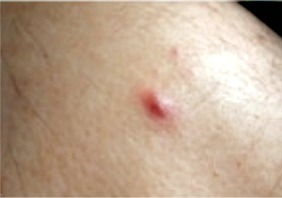
Common Boil
Treatment Options
What is a boil and what's the best way to treat it? While they vary in size, boils can become extremely painful, sensitive to touch, red, and swollen.
And sadly, some people are more prone to boils and tend to get them over and over again……a condition called furunculosis.
Just what is a boil? Well, simply put - it's a skin or hair follicle infection.
Boils (also known as furuncle) are usually caused by bacteria
called Staphylococcus aureus.
Over time, as the infection increases, boils usually develop a
white (sometimes yellow) center that's filled with infectious pus.
In fact, if you look at various pictures of boils – you may notice they look similar to a small pimple with a whitehead in the center………but don't start searching for help for acne because it won't help.
These pus filled bumps won't respond to acne treatments and should be treated carefully to reduce the risk of spreading the infection.
Sometimes the center can get so big, it can bust on its own,
but most times it best to either use warm compresses or have them
drained (known as lancing) by a doctor.
Complications from boils are usually minimal - including risk of spreading the infection to other parts of the body. However, sometimes it can be serious.
The infection can spread to the bloodstream – which
can be very serious. That's why it's a good idea to see a doctor if you
experience any severe symptoms.
Boils can pop up anywhere on the body, but it seems the common areas are in the groin or buttocks.
These types of boils usually start from an ingrown hair (click here to read more about what causes boils on buttocks).
If you develop them on the hands or fingers, be extra careful since the infection can spread to other parts of the body or even family members.
Personal hygiene is very important.
Types of Boils
Pictures and symptoms can vary greatly, which is why people are always asking what is a boil and what do they look like?
Well here we'll
cover the 4 most common types of boils.
Furuncle or carbuncle. This type of skin abscess is caused by a bacterium called Staphylococcus aurus. It is often accompanied by fever or chills.
Cystic acne. This type of boil occurs when oils ducts
become clogged and infected. It is most common on the face. It is
particularly common in adolescents.
Hidradenitis suppurativa. With this condition,
multiple skin boils form in the armpits or groin due to infected sweat
glands. Antibiotics are usually not effective and a surgical procedure
to remove the sweat glands is usually required.
Pilonidal cysts. These skin boils usually form in the crease of the buttocks. They begin as tiny infections of the hair follicles.
The irritation from the direct pressure of sitting causes the inflammation to grow. These boils often form after long trips when one has been sitting for prolonged periods of time.
Conventional Boil Treatment
The most common conventional treatment includes keeping the area clean.
Using a good skin wash that helps kill bacteria and prevent it from spreading is a good idea.
Soaking the boil in warm water or placing a warm compress can also help encourage natural draining.
In some cases, antibiotic creams can help with healing.
If the case if very severe or painful or the boil
is in a sensitive area.....your some doctor may prescribe antibiotics
and anti-inflammatory drugs to reduce infection and pain.
This is usually the course of treatment for recurrent boils in sensitive areas. However, continued use of antibiotics increases ones chance of becoming resistant to the drug.............
Which makes it less effective
against the bacteria that causes boils.
Which is why this course of treatment is usually not the best options for those so prone to boils.
Visit home treatment of boils for tips on natural ways to treat and possibly help eliminate reoccurring boils from developing.
It's best not to wait too long to seek treatment.
Once infection
sets-in you'll most likely need to see a doctor or possibly have to take
antibiotics - which can further lower your immune system - which can
increase your chance of further boil outbreaks.
Please don’t wait to treat a boil. Once infection sets in you will need to see a doctor and take toxic antibiotics which can further lower your immune system setting you up for a greater chance of further boil outbreaks.
Additional Reading
Pictures of Boils - Still unsure what is a boil? Learn more here....and see a variety of photos..

Popular Articles


Watch how I reduced crepey skin under my eyes....
As an Amazon Associate I earn from qualifying purchases. Other links on this site may lead to other companies I'm associated with.


Recent Articles


-
Easy Eye Solutions - Under Eye Lines & Crepey Skin. See My Results!
Jun 29, 21 04:20 PM
Easy Eye Solutions Instant Eye Tuck Serum. Free Shipping & Sample Sizes. See before and after video -
Crepey Skin Remedies - Natural Cure for Face, Eyes and Neck
Nov 04, 20 02:53 PM
 Crepey Skin Remedies - Crepey skin can be reversed naturally at home. See before & after pictures of my results.


